Most IT services founders treat their CRM like a digital filing cabinet. It is a place where data goes to die. You spend thousands of dollars on HubSpot or Salesforce licenses, yet your sales team still complains about manual entry while your pipeline remains a black box.
If you are a founder or CEO of a growing IT firm, you know the frustration. You want predictable revenue, but your current "system" relies on people remembering to update records, manually researching leads, and sending "just checking in" emails.
This is what I call a Static CRM. It is a passive repository of information that requires constant human nagging to stay relevant.
In my twenty years of building sales systems, I have found that the biggest bottleneck to $50k+ sales cycles isn't a lack of talent. It is a lack of infrastructure. Strategy without execution has no value, and in 2026, execution requires operationalizing AI.
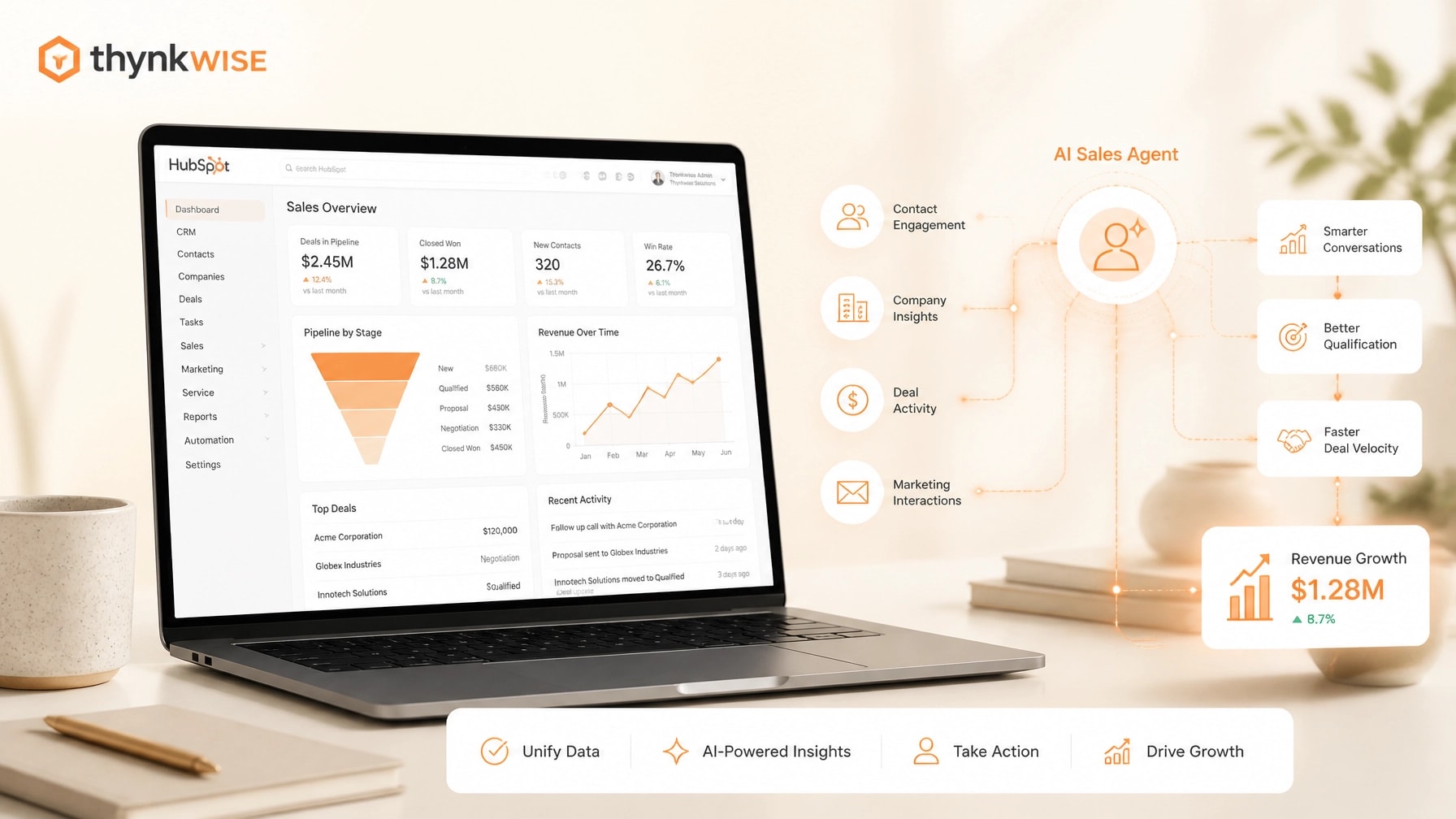
At thynkWISE (where WISE stands for We Inspire Sales Experts), we focus on turning that Static CRM into an Active Revenue Engine. The secret lies in integrating AI Sales Agents directly into your HubSpot environment.
The Death of Sales Productivity: Manual Entry
The quickest way to kill a high-performing sales person's morale is to turn them into a data entry clerk.
When your sales team spends 40% of their time researching LinkedIn profiles, guessing email addresses, and logging call notes, they aren't selling. They are doing administrative work that an algorithm can do better, faster, and cheaper.
For an IT services firm, where sales cycles are long and consultative, this manual overhead is a silent margin killer. You are paying executive-level salaries for entry-level data processing.
"Simple is always smart" is our core philosophy. The simplest way to scale your sales without doubling your headcount is to move the "busy work" from humans to AI agents.
The Infrastructure Pillar of the FIT Formula
When I work with founders, we use a framework called the FIT Formula. It stands for Foundation, Infrastructure, and Transformation.
Infrastructure is the engine room of your sales organization. It is the CRM, the automation, and the data flows that allow your team to operate at scale.

Without a robust infrastructure, your sales strategy is just a collection of good intentions. By integrating AI agents into HubSpot, you are building a system that executes your strategy automatically. These agents act as your "Digital SDRs," handling the heavy lifting of:
- Lead Research: Automatically enriching contact records with technical stacks, recent news, and intent signals.
- Initial Outreach: Crafting personalized, context-aware emails based on real-time data.
- Meeting Scheduling: Managing the back-and-forth of calendar coordination without human intervention.
Moving from Static CRM to an Active Revenue Engine
An Active Revenue Engine doesn't wait for a human to click a button. It responds to triggers.
Imagine a scenario where a prospect visits your pricing page. In a Static CRM, nothing happens until the prospect fills out a form. In an Active Revenue Engine, an AI agent detects the visit, researches the company, identifies the key decision-makers (the "Y" in thynk, which represents You, the prospect), and drafts a personalized message for your account executive to approve.
This shift creates predictable revenue because it removes the variability of human effort. AI agents don't have "off days." They don't forget to follow up. They ensure that every lead follows the exact same journey every single time.
How to Operationalize AI Agents in HubSpot
You do not need a degree in data science to make this work. You just need a clear execution roadmap. HubSpot has recently made this easier with the introduction of "Breeze," their native AI layer, but you can also integrate specialized external agents for more complex workflows.
Step 1: Enable HubSpot AI and Data Access
Before you can deploy agents, your CRM needs permission to use your data. Navigate to your HubSpot settings under Account Management and enable generative AI tools. This allows the AI to read your contact history, deal stages, and email threads to gain context.
Step 2: Define Your "Selling Profile"
An AI agent is only as good as the instructions you give it. You must define your Ideal Customer Profile (ICP) within the system. For IT services, this includes:
- Target industries (e.g., Fintech, Healthcare, SaaS).
- Technical requirements (e.g., companies using AWS, Azure, or specific legacy systems).
- Pain points (e.g., cybersecurity compliance, cloud migration, DevOps bottlenecks).
Step 3: Deploy Inbound and Outbound Agents
I recommend a two-pronged approach:
- The Customer Agent (Inbound): Replace your basic chatbots with a Customer Agent trained on your technical documentation and case studies. This agent can qualify leads in real-time, answering complex questions about your services before booking a meeting directly into an AE's calendar.
- The Prospecting Agent (Outbound): Use this agent to scan your target account list. It can identify high-intent triggers (like a new CTO hire or a recent funding round) and draft outreach that sounds like it came from a human, not a template.
Step 4: Bidirectional Data Flow
This is the most critical step. Your AI agents must be able to write data back to HubSpot, not just read it. When an agent learns that a prospect is using a specific competitor, that information should automatically update a custom property in HubSpot. This ensures your CRM is always the single source of truth.
Predictable Revenue is a System, Not a Miracle
Predictability comes from discipline. When you automate the "Infrastructure" of your sales process, you create a baseline of activity that is constant.

With AI agents handling the top-of-funnel activity, your sales leaders can focus on what they do best: closing complex deals and building relationships. You move from "hoping" for leads to "knowing" exactly how many qualified opportunities your system will generate next month.
The ROI of this integration isn't just in saved time. It is in the increased conversion rates that come from speed-to-lead and hyper-personalization. In the IT world, being the first to respond with a relevant solution is often the difference between winning a $100k contract and being ignored.
Strategic Questions for the CEO
As the leader of your organization, you should not be managing the AI agents yourself, but you must lead the shift toward an automated infrastructure. Ask yourself:
- How much of my sales team's time is currently spent on non-selling activities?
- Is our CRM a source of intelligence or just a list of names?
- What is the "Cost of Inaction" (COI) of continuing to run a manual sales process while competitors adopt AI?
- If I stopped selling tomorrow, does my company have a system that continues to generate opportunities?
Execution is the only thing that separates a visionary founder from a frustrated one. At thynkWISE, we don't just consult on strategy. We help you build the systems that make growth inevitable.

Integrating AI sales agents into HubSpot is the simplest way to regain your time and secure your revenue. Start small, operationalize the infrastructure, and watch your sales engine transform.
Simple is always smart.